AMBIT
AMBIT (adaptive mentalization-based integrative treatment), cofounded by Dickon Bevington and Peter Fuggle, is an approach to organising and delivering help for clients or patients whose needs are multiple and intersecting, who often present with high risk, and who may not be experienced by conventional services as conventionally ‘help-seeking’ on account of low levels of trust in helping systems. The life trajectories of such a population are often marked by great suffering and high service demands on account of the risks they present and the functional impact of the multiple burdens they carry. Very often these people have long experience of marginalisation, oppression and exclusion.
In this sense, AMBIT is a transdiagnostic approach to treatment.
AMBIT was developed from the start as an open source approach to treatment development, and constructed over many years using direct feedback from the hundreds of teams and workers that were trained from Anna Freud. In that sense its development has been a collaborative effort, and if its content now speaks to the lived experience of workers in the field and their many and varied clients, this is a reflection of the ‘bottom-up’ elements in its development that were so crucial in shaping the application of experimentally-derived theory. From its earliest inception, the AMBIT approach was documented and incrementally adapted and refined in the transparent and fluidly adaptable context of an online wiki, based on the open source TiddlyWiki . The original AMBIT online manual is available for all to view and contains a wealth of writing, videos, exercises, and downloads which mean that teams can theoretically train themselves (though our experience of training suggests that this is very hard, and that the presence of ‘outside minds’ that can act as guides, explainers, and critical friends, makes the process of team change much easier.
AMBIT is not an approach that lone practitioners can use because it is fundamentally about the networked nature of mentalizing (mentalizing is helpfully thought of as less an individual ‘skill’ or ‘power’, and more a function of that individual’s social capital - in the form of their access to other mentalizing minds.)
AMBIT supports workers in teams to develop and hold onto a mentalizing stance in relation to their clients, accepting that in order to do so an equity of mentalizing efforts will be required alongside their face to face client encounters, to include their team-mates, the workers in the wider informal, inter-professional and inter-agency networks they all inhabit, and in relation to the team’s approach to learning from this endlessly shifting and variously challenging work.
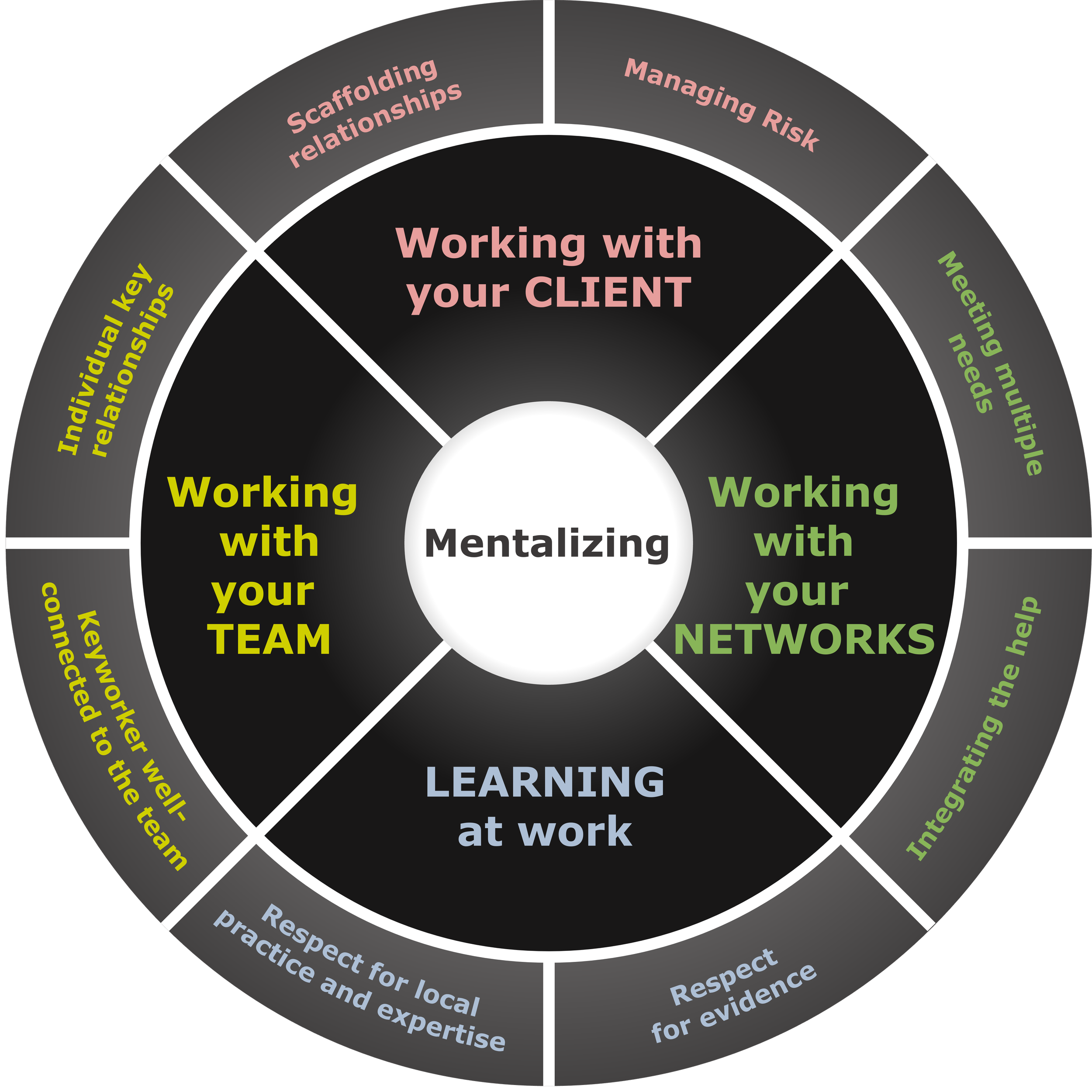
The AMBIT wheel (above) summarises the core features of the approach:
Mentalizing is at the centre, the ‘load-bearing axle’ as it were. Effective and sustainable work (moving the wheel forwards, through supporting meaningful change) can only be achieved if mentalizing is active, and actively sustained, in all four quadrants of the wheel. AMBIT suggests numerous techniques and processes to support this in each quadrant that teams can practice and may want to adopt as part of their team culture. Around the rim of the wheel are eight paired practice principles. Each pair are often experienced as contradictory in practice; to get one ‘right’ often means sacrificing something of the other. This speaks to the reality of clinical practice, where workers must constantly balance competing priorities. AMBIT may thus be likened to training for tightrope walkers (!) in that it does not promote unrealistic concrete demands (“just do X and all will be well”) but helps workers to accept the inevitability of ‘wobbling’ in this work. AMBIT allows teams to practice how safely to predict the need for, and enact, the constant corrections that constitute ‘holding the balance’, while systematically creating contexts (a “team around the worker”) where they are held in sight/in mind and can hear (and offer) the corrective feedback that every person/system needs.
AMBIT has been described in numerous books and peer-reviewed papers (see Publications at the bottom of the About section) and in the open source online wiki, in which AMBIT was developed: https://manuals.annafreud.org/ambit . Hundreds of teams across the world , in a startlingly wide range of settings and professional contexts, have received training in AMBIT and there is an active worldwide community of practitioners and researchers centred around Anna Freud, where the main training programme is located under the Directorship of Liz Cracknell and Laura Talbot.